
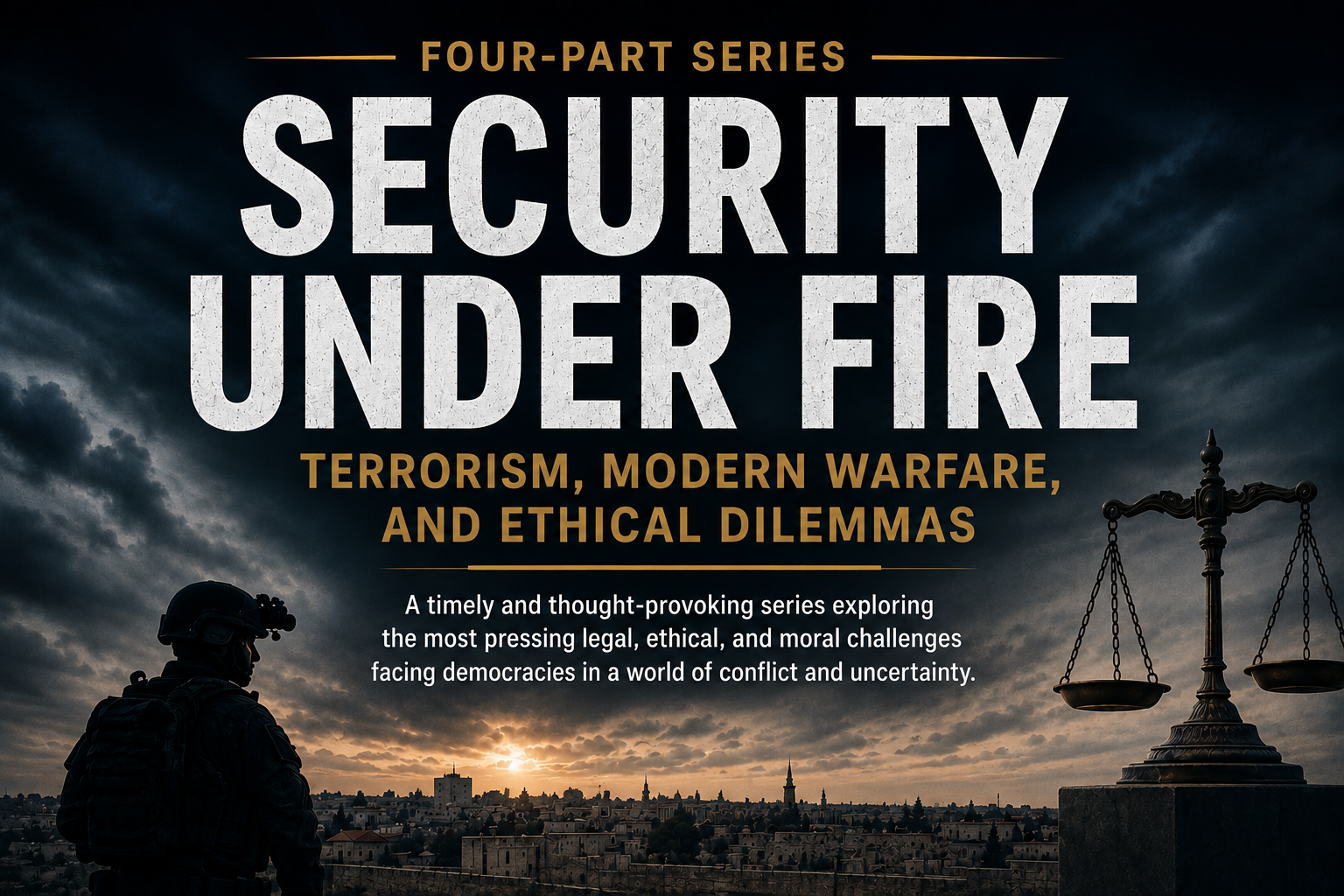
Security Under Fire: Law, Ethics, and the Challenges of Modern Conflict
In a world shaped by terrorism, hostage crises, regional wars, nuclear threats, and rapidly evolving questions of national security and international law, some of the most difficult legal and moral dilemmas facing modern democracies have taken on renewed urgency. This four-part series explores these pressing issues through a unique multidisciplinary lens that integrates U.S. constitutional law, international law, Israeli legal doctrine, public policy, ethics, and Talmudic jurisprudence. Through timely case studies, landmark legal decisions, and enduring philosophical debates, participants will engage with profound questions involving security, human rights, self-defense, hostage negotiations, interrogation policy, territorial compromise, and the ethical responsibilities of democratic societies confronting existential threats.
This Course offers 6 MCLE General or Ethics credits.
Dates: 4 consecutive Wednesdays starting June 3.
Two Convenient Locations (Chicago Loop and Evanston):
Both classes will also be availabe on ZOOM.
Location 1 - Chicago Loop, Wednesdays at Noon
Time: 12:00 PM - 1:30 PM
Law Offices of Stone Pogrund & Korey
8 S Michigan Ave Suite 333, Chicago Loop
Location 2 - Wednesdays in the Evening
Time: 7:30 PM - 9:00 PM
Chabad Community Center
825 Clark St, Evanston
--
Detailed Syllabus
Week 1: The Ticking-Bomb Dilemma – National Security, Human Rights, and the Limits of Interrogation
In an age of global terrorism, hostage crises, and heightened national security concerns, democratic societies continue to confront one of the most difficult legal and moral questions of our time: Can extreme interrogation methods ever be justified to prevent catastrophic harm? This class explores the modern “ticking-bomb” dilemma, examining the tension between protecting public safety and preserving fundamental human rights. Participants will analyze landmark legal cases, counterterrorism policies, and ethical debates surrounding coercive interrogation, necessity defenses, executive authority, and emergency powers, while comparing contemporary legal frameworks with enduring principles found in Talmudic law.
Week 2: The Hostage Dilemma – Ransom, Prisoner Exchanges, and the Cost of Saving Lives
From the Gilad Shalit prisoner exchange to the recent Gaza hostage crisis, democratic societies continue to face one of the most agonizing legal and moral questions imaginable: Should governments negotiate with terrorists, pay ransom, or release dangerous prisoners in order to save innocent lives? This class examines the complex legal, ethical, and policy dilemmas surrounding hostage negotiations, ransom payments, and prisoner exchanges. Participants will explore federal laws prohibiting material support to terrorist organizations, the legal doctrines of necessity and duress, Israeli hostage negotiation policies and landmark legal decisions, and the enduring Talmudic debate over “overpaying” for captives, all while confronting the difficult balance between saving innocent lives and protecting broader public safety.
Week 3: Lightning Strike – The Ethics and Legality of Preemptive Military Action
From Israel’s preemptive strike in the Six-Day War to contemporary threats posed by Iran’s nuclear ambitions, missile proliferation, and proxy warfare, nations continue to confront one of the most consequential questions in international law and military ethics: When, if ever, is a preemptive strike justified? This class explores the legal, ethical, and strategic dimensions of anticipatory self-defense. Participants will examine the principles governing the use of force, the doctrine of imminent threat, and evolving debates surrounding preventive versus preemptive warfare, while analyzing historic and contemporary case studies involving Israel’s military actions and the difficult balance between military necessity, civilian protection, political pressure, deterrence, and long-term strategic consequences.
Week 4: Land for Peace? – Territory, Security, and the Search for Lasting Resolution
Since the Six-Day War transformed the map of the Middle East, the question of whether territory can or should be exchanged for peace has remained one of the most consequential and divisive issues in international diplomacy and national security. From the Camp David Accords and the Oslo process to ongoing regional instability, the rise of Iranian influence and proxy warfare, repeated rocket attacks following territorial withdrawals, and the shifting geopolitical landscape of the Middle East, the debate over Israel’s borders and disputed territories continues to shape global politics and legal discourse. This class examines the legal, ethical, historical, and strategic dimensions of “land for peace” through the frameworks of international law, Israeli constitutional and security considerations, diplomatic precedent, and Talmudic jurisprudence.
| Course Registration Fee | $150.00 |